|
Fire Extinguisher Service and Inspection
|
|||||
|
Anubis Systems Technologies’ trained professionals are committed to ensuring your project’s fire extinguishers are serviced, maintained, and inspected to the highest standards in the industry. We partner with several Lower Mainland service facilities to ensure timely recharging and the properly certified internal maintenance and hydrostatic testing is performed on your portable extinguishers. Our services are competitively priced and leave nothing to chance. For more information you can email us or telephone (778) 863-7147.
|
|||||
|
In order to understand how a fire extinguisher works, we need to delve into some basic fire chemistry (don’t worry, you won’t require advanced chemical knowledge to participate). Many fire service industry websites commonly mention something called the fire triangle. Simply put, imagine a triangle with three equal sides (the mathematical term for one is an equilateral triangle). Well, each side of the fire triangle represents one of three required items you need to start and sustain any kind of fire. They are:
If you take away or interfere with any side of the triangle, you will successfully extinguish a fire EVERY TIME. Interfere with more than one and you’ll extinguish it faster. Early man used dirt (sand) and water to extinguish their campfire (a combination you’ll often find people using today when they’re camping recreationally and want to make sure their fire is really out before moving on). Old-time fire engines (of the horse-drawn variety) used to carry sand in buckets attached to the sides for just this purpose (it also aided in preventing the engine’s horses from slipping on wet or icy roadways). Fire extinguishers have been purposely designed to interfere with one (or more) side of our fire triangle. Smaller extinguishers (the five and ten pound units most people are familiar with and see hanging everywhere) are designed to extinguish fires in the incipient stage (when the fire is small or has barely gotten started). Extinguishers sold in North America are classified into several categories (called classes) depending on what kind of fuel is involved: |
|||||
|
|
CLASS A |
Common household items like wood, paper, cloth |
|
||
|
|
CLASS B |
Flammable liquids, plastics, solvents, and gasses |
|
||
|
|
CLASS C |
Energized electrical equipment and circuits (transformers, distribution panels, motors, small appliances, etc.) |
|
||
|
|
CLASS D |
Combustible metals like phosphorus, sodium, and powdered aluminium (often used in solid fuel rockets) |
|
||
|
|
CLASS E (or K) |
Cooking oils, kitchen grease, and fats |
|
||
|
|
|||||
|
So, what makes up a modern extinguisher? There are three common types of extinguishers in service today: |
|||||
|
|
|
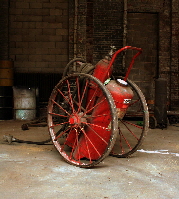
Cartridge based units (like the large wheeled unit to the left) utililze a high pressure nitrogen cylinder (the propellant) attached to a larger bottle which contains the agent. Prior to use, you’re required to activate the the unit which causes the nitrogen to pressurize the larger bottle and then utilize the hose and nozzle to direct the agent at the base of the fire in broad sweeping motions. These types of wheeled units often contain a special compound of potassium bicarbonate (known in the industry as Purple K) and the unit is classified BC (designed to extinguish both Class B and C type fires). You’ll often see these units deployed on and around airport aprons in close proximity to parked aircraft. |
|
||
|
|
|
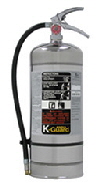
Low pressure cylinders (the most common type seen today) employ a metal shell (usually spun aluminum or welded steel) which contains both the extinguishing agent and the propellant. As you can see from the image to the left, it sports a convenient combination carry handle and actuator at the top. To activate this unit, you need to pull the pin located just above the pressure gauge, aim the nozzle at the base of the fire, and depress the top lever while sweeping the nozzle from side to side to spread as much agent over the area as you can. The cylinders come in a variety of finishes. White, red, blue, and brushed (or polished) aluminum or steel. Typical pressure in the cylinder ranges from 160 PSIG to 250 PSIG. Depending on the agent used in the cylinder, the extinguisher can be rated as BC, ABC, D, or K. |
|
||
|
|
|
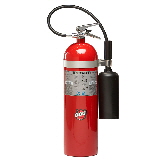
High pressure cylinders employ a steel shell and utilize CO2 (Carbon Dioxide) as both the agent and propellant. The CO2 cylinder doesn’t employ a gauge, so the only way to ensure the unit is fully charged is to weigh it. Typical pressure in the cylinder is about 1800 PSIG. The minimum full weight will always be shown on the label. This type of extinguisher is rated BC. |
|
||
|
|
|
|
|||
EXTINGUISHER FAQWhat is a six year maintenance? All internal cylinder examination (part of the six year maintenance procedure on dry powder extinguishers) MUST be performed by a registered Transport Canada or Warnock Hersey certified Cylinder Requalification Agency. What is a hydrostatic test (also called a hydro-test)? All hydro-static testing MUST be performed by a registered Transport Canada or Warnock Hersey certified Cylinder Requalification Agency. When should I use a fire extinguisher? How often must a fire extinguisher be inspected or checked? Can you tell us what a monthly inspection has to check? NFPA 10 (2007) Sentence 4.4.1 required all stored pressure extinguishers manufactured before October 1984 be removed from service at the next maintenance interval (six year or hydrostatic test). Is there some sort of phased replacement we can implement in our building which has about twenty such units? |
|||||
|
|
|
|
|
||


|

|
Building Life Safety, Security, and CCTV Systems |
ULC Fire Alarm Monitoring |
Building Life Safety Audits |